SiMuR Movement TechnologyMultisensor Systems and Robotics, University of Oviedo

Research programme

One question runs through our work: what it takes for a value obtained with wearable sensors, outside the laboratory, to count as a measurement. Four topics follow it from the sensor node to the joint angle and its uncertainty.

The problem behind every topic

Measuring a joint angle with body-worn sensors requires placing a network of sensors on a moving body, knowing at all times how each sensor is oriented relative to the joint, and delivering a value with its metrological properties. Each requirement is a research problem: which sensor errors and placements are admissible, how to calibrate from the person's own movement, and how to give each value an uncertainty that follows the conditions of use.

A wearable measurement is not valid in every condition. Part of the result is to state the domain in which it holds, and to make the system recognise from its own signals when it is outside that domain.

Four topics, one programme

For each topic we separate what is already published from what is work in progress.

A wearable inertial node held between gloved fingers

1. Sensor nodes and their metrology

Which sensor errors are admissible for a given movement variable? We design our own wearable inertial measurement units and characterise them: noise, bias stability, scale factor and axis misalignment.

Published
Design and characterisation of a wearable inertial node (Sensors 2024); extended-bandwidth node for rapid events such as impacts (Sensors 2025); magnetometer-less orientation evaluated under static and dynamic conditions on a robotic test bench (IEEE TIM 2026).
In progress
Time synchronisation and acquisition in multi-node networks.
Publications on this topic

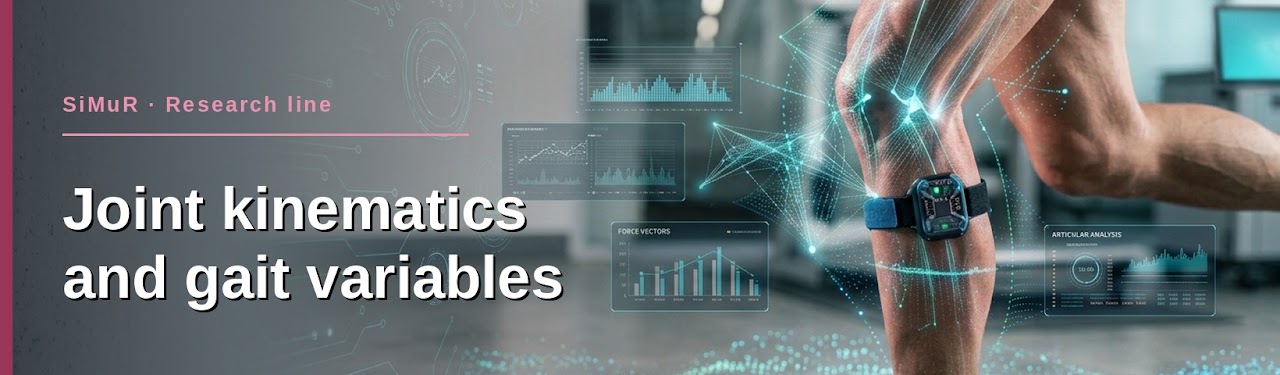
A wearable sensor strapped below the knee of a runner

2. Joint kinematics

How can the orientation of each sensor relative to the joint be obtained from the person's own movement, without a specialist? We work on sensor-to-segment calibration and joint angle estimation, with model-based and learning-based methods.

Published
Motion calibration for one-degree-of-freedom joint angles (IEEE EMBC 2025); calibration-free estimation with recurrent networks and a physics-informed self-supervised approach (IEEE I2MTC 2026); upper-limb joint angles in occupational health (CMBBE 2016).
In progress
Joints with several degrees of freedom; multi-segment kinematics of the spine and trunk; estimation from a reduced set of sensors with biomechanical priors.

Publications on this topic

A person walking along a corridor, seen from behind

3. Gait and spatio-temporal variables

Which gait descriptors can be obtained from one or two sensors on the trunk or the limbs? This is the group's longest-running topic: gait events, contact times, step length, speed, distance and slope.

Published
Gait event detection from lower-trunk accelerations (Gait & Posture 2010); distance estimation by accelerometry (Sensors 2018); waist-worn pedestrian navigation (Sensors 2012); ground contact time from the upper arm and upper back (Sensors 2023).

Publications on this topic

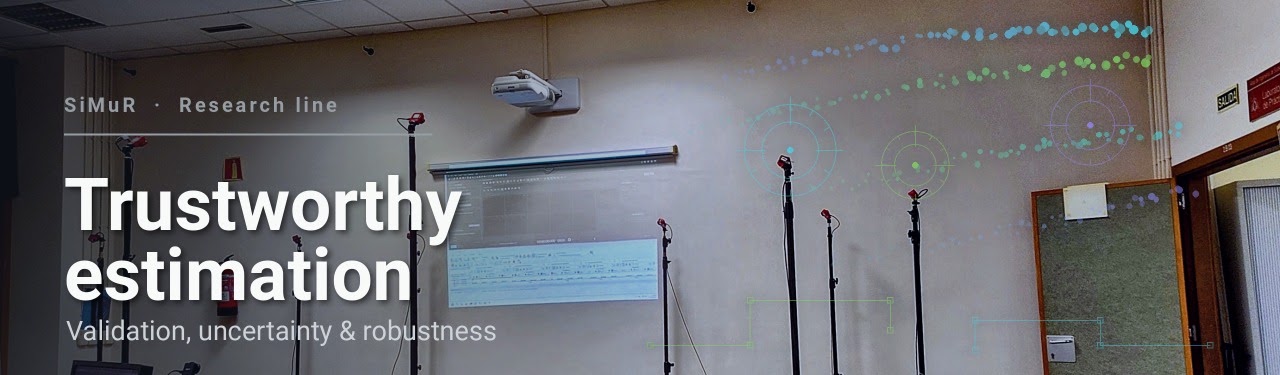
The MovLab laboratory with its optical cameras on tripods

4. Uncertainty and operating domain

How can each estimate carry an interval that is checked against a reference, and how can the system detect that it has left the conditions in which that interval holds? This topic is where the other three converge, and it is the most recent.

Published
Metrological evaluation of our own optical reference with an industrial robot (Sensors 2021); errors of orientation estimation isolated on the robotic test bench (IEEE TIM 2026).
In progress
Coverage intervals per joint (conformal and Bayesian methods); detection of sensor displacement, magnetic disturbance and other situations outside the validated domain; field checks of the declared uncertainty.
A researcher reviewing inertial signals on two screens

Supporting line: activity recognition

Outside the laboratory nobody prescribes the movement, so the system has to recognise what the person is doing before a measurement can be interpreted. We recognise activity from thigh, wrist and trunk accelerometry and study how the result depends on sensor placement, the use of the gyroscope and the level of detail of the activity labels.

Published
Effect of gyroscope, sensor placement and activity granularity on recognition performance (Sensors 2026); recognition from thigh and wrist accelerometry (ESANN 2024).

Publications on this line

Verification without a perfect reference

In people there is no exact reference: optical motion capture with skin markers is affected by soft tissue too. We verify in levels, each with its own declared uncertainty. A robotic test bench isolates the errors of the sensor and the algorithm; the optical laboratory provides the reference in people; and field checks show whether the declared uncertainty is consistent with what is observed outside the laboratory.

MovLab and the robotic test bench · Application domains